The Business Building Machine
A practical, phase-based framework for building, launching, and growing a business in the right order. Six sequential phases. One clear path forward.
Why the Order Matters
Most businesses waste time and money not because they made bad marketing decisions, but because they made them in the wrong order.
A business that runs Google Ads without a converting website wastes every dollar. A business that builds a website without a defined offer confuses every visitor. A business that hires an SEO agency without demand data builds content nobody searches for. None of these are marketing failures — they are sequencing failures.
The Business Building Machine solves this by mapping out the exact order in which business systems should be built. Each phase builds on the last. Each completed phase unlocks the next. Nothing is built before its time.
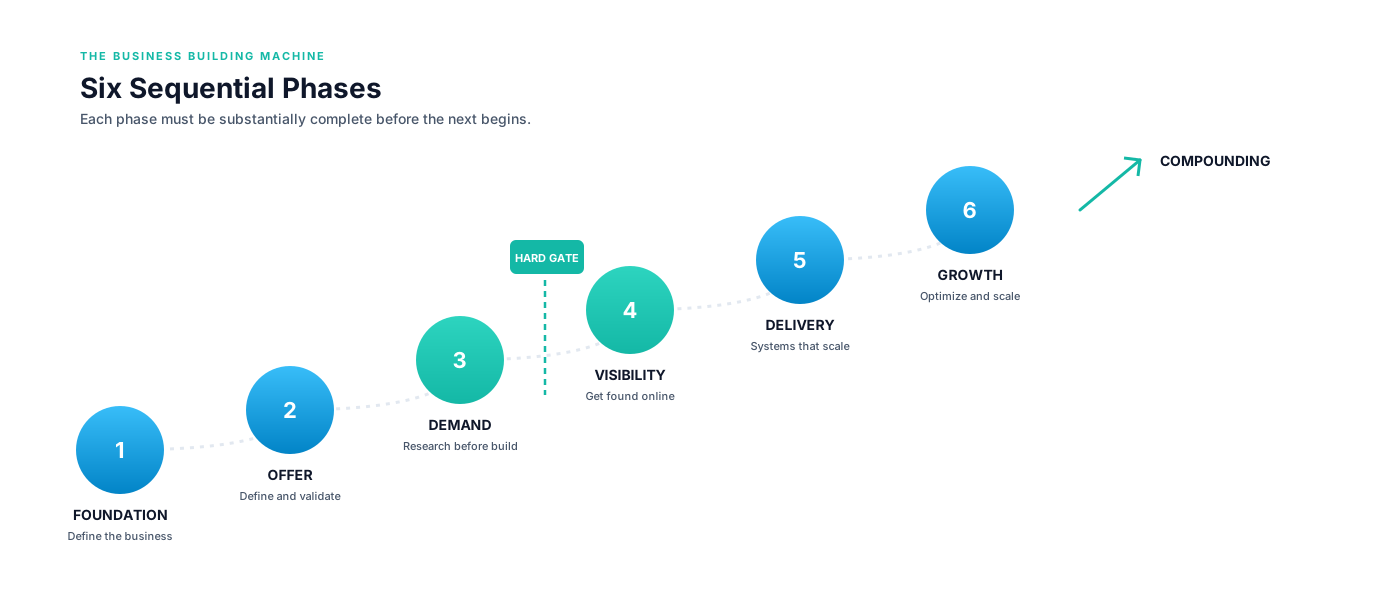
Six Sequential Phases
Each phase must be substantially complete before investing in the next. This is not a checklist — it is a dependency map.
Foundation
Define what the business is before building anything.
Before any website, offer, or marketing asset is created, the business needs a clear foundation. This includes defining the mission, identifying the target market, describing the ideal customer in detail, naming the core problem being solved, establishing how the business wins against alternatives, and setting a minimum-viable brand identity.
You’re done when: you can describe your ideal customer and your positioning in one paragraph each, without thinking.
Offer
Define what you sell, what you charge, how you sell it, and prove someone will pay for it.
Once the foundation is clear, the business needs one well-defined offer with a clear price, a clear outcome, a clear sales process, and concrete evidence that someone will pay for it. Validation is built into this phase — not a separate step. Without evidence, everything downstream is theoretical. A business with a great offer and zero proof is not ready to invest in a long-term website, a content strategy, or scaled paid acquisition.
You’re done when: you can state your offer, price, and sales process on a sticky note, AND you have concrete evidence someone will pay for it.
Validation methods — any of these count
Demand
Find out where your customers actually are before building anything permanent.
Before a polished website is built or a content strategy is funded, the business needs a real map of where its customers spend attention. What are they searching for? What platforms are they on? What referral channels actually drive inquiries? What did your Phase 2 paid tests teach you? This research determines what pages to build, what content to create, and which channels deserve real investment.
You’re done when: you have a documented map of where your customers actually are — what they search for, what platforms they use, or what referral channels drive your inquiries — and you’ve used that map to decide what to build next.
Visibility
Get found consistently through the channels your customers actually use.
With demand data in hand, the business builds its visibility infrastructure: a website or landing-page system structured around your real channels, SEO foundations where search is part of the mix, paid landing pages where ads are part of the mix, and the tracking systems needed to measure what is working. This is when the permanent assets get built — not before.
You’re done when: your website or landing-page system captures inbound leads consistently, with real tracking data showing where they came from and what they did.
Delivery
Build the backend systems that let the business deliver reliably at scale.
Once leads are coming in, the business needs systems to handle them. CRM setup, automated follow-up, onboarding flows, client communication systems, and documented delivery processes. Without these, growth creates chaos. With them, growth becomes replicable.
You’re done when: a new lead can move from inquiry to delivered work without you remembering to do anything manually.
Growth
Scale what’s already proven — deliberately, with real budget behind it.
Phase 6 is not when you first try paid ads — that may have happened in Phase 2 as a validation test. Phase 6 is when you put real, sustained budget behind the channels you’ve already proven work, optimize conversion rates across the funnel, and build the reporting systems that let you grow without breaking what’s behind it. Scaling a broken system creates faster failure. Scaling a proven system creates compounding growth.
You’re done when: you have at least one acquisition channel proven to return more than it costs, AND a documented path to scale it without breaking the systems behind it.
The Three Core Rules
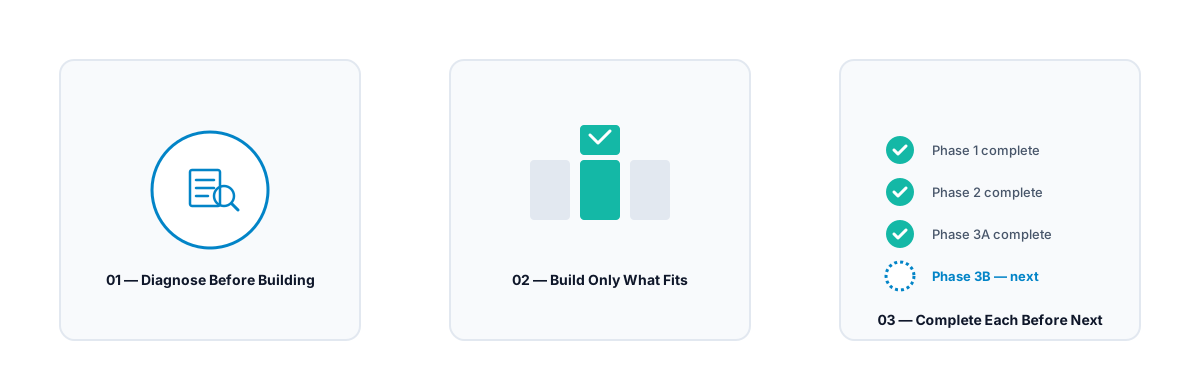
Diagnose Before Building
Every engagement starts with identifying the current phase. No recommendations are made before the diagnosis is complete.
Build Only What Fits the Phase
A Phase 1 business does not get a website recommendation. A Phase 3 business does not get paid ad advice. The phase determines what gets built.
Complete Each Phase Before the Next
Skipping phases does not save time — it creates rework. Each phase is a prerequisite for the one that follows.
Not Sure Which Phase You’re In?
Take the free assessment and we’ll identify your current phase and what to build next.